Market
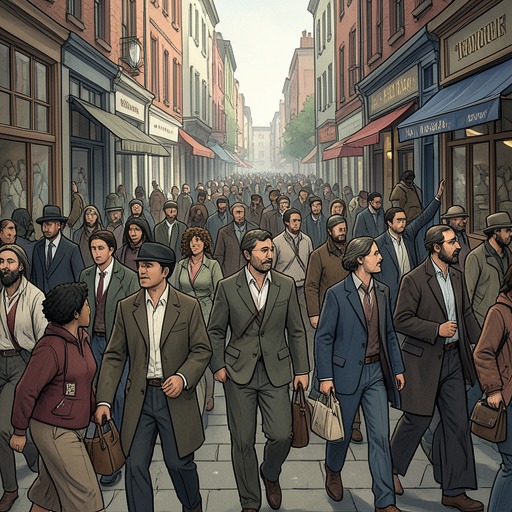
Naked LunchMarket is a central public space in Interzone, at once a commercial district, a stage for political display, and a gathering place where social tensions become public conflict. Its movement from ordinary street life to panic, police violence, and a bloodied aftermath makes it one of the book’s clearest settings for the collision between civic spectacle and coercive authority.
Public Space and Political Theater
Market is presented as a place where different groups and performances share the same streets. During a luncheon held on a balcony overlooking the district, members of the Nationalist Party eat and drink while the Party Leader moves among them in a jellaba, cigar in hand. His expensive English shoes, conspicuous socks, and forceful bearing make his public image look less like sober statesmanship than gangsterism staged as political respectability. When he points toward the district and asks his lieutenant what he sees, the answer is simply Market: the urban scene itself becomes the object of political rhetoric.
The Party Leader’s balcony is one vantage point on the district, but the streets below also accommodate more disruptive forms of performance. A. J. strolls through Market wearing a black cape, with a vulture perched on his shoulder, and pauses beside a table of agents. His conspicuous entrance makes him another public spectacle among many, distinct from the Party’s organized ceremony but equally attuned to the power of display.
Market’s public life is not restricted to official politics. Sour Nationalists sit outside the Sargasso, sneering at queens and speaking Arabic, when Clem and Jody sweep in dressed like a caricature of capitalists in a communist mural. They announce that they have come to feed on their opponents’ backwardness. Their confrontation places political insult, costume, and social antagonism in the open, with the district serving as a stage on which groups make themselves visible by provoking one another.
A District of Stories and Encounters
The book also presents Market as a setting for the circulation of talk and anecdote. In a club bar, an English colonial, assisted by five police boys, detains a subject and launches into an extended account of illness and travel. His story shifts from malaria to dysentery as the evening continues. The episode gives the district an atmosphere crowded with self-appointed storytellers and captive listeners: public entertainment can become a form of social pressure, and an encounter in a bar can turn into an unwilling audience’s ordeal.
That talkative social world stands beside the district’s more overt performances of power. The Party Leader’s luncheon, A. J.’s appearance, and Clem and Jody’s arrival all draw attention to clothing, gestures, and public address. Market thus gathers not a single community speaking with one voice, but competing displays of status, political identity, and provocation. Its role in the book is partly spatial: it places these otherwise separate kinds of performance within a shared civic arena.
Riot and Police Crackdown
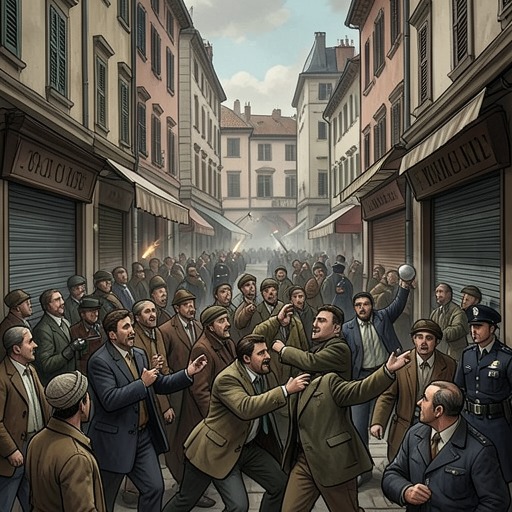
The social antagonisms visible in Market become a riot. As panic spreads, shop shutters slam shut; drinks and trays hang momentarily in the air as patrons are swept inside. The inhabitants’ hurried retreat turns the district’s ordinary public surfaces—shops, tables, and streets—into signs of a sudden collapse in security. A group of queens rushes into a drugstore and buys a case of lubricant, fearing sexual assault amid the disorder. The detail registers the fear and frantic self-protection of people caught in the violence without making the scene a spectacle of injury.
The Party Leader responds to the outbreak as though it confirms a political performance. Holding up his hand, he calls it the voice of the People. The declaration contrasts sharply with the panic around him: rather than treating the riot as evidence of danger or social breakdown, he claims it as an expression of popular will. His gesture turns disorder into political theater even as the district’s residents seek shelter.
Police squads enter Market from every approach, moving in from the streets that lead into the district. They beat and kick rioters with deliberate, systematic brutality. The response changes the immediate balance of power: the riot is no longer only a conflict among people in the streets but an occasion for state force to impose itself across the public space. The account emphasizes the orderly, methodical character of the crackdown, setting it against the panic and confusion of the crowd.
Aftermath and Significance
After the police operation, the rioters are carried away in trucks. The shutters rise again, and Interzone’s citizens emerge into a square littered with teeth and sandals and slick with blood. The reopening of the shops marks a return to public life, but the scene makes clear that this recovery follows a violent suppression rather than a resolution of the conflicts that produced the riot.
Market therefore functions as more than a backdrop for separate episodes. The balcony luncheon reveals political authority as carefully staged display; the street encounters show how competing groups occupy the same space through costume, talk, and provocation; and the riot demonstrates how quickly public performance gives way to fear and force. The Party Leader’s claim that the crowd speaks for the People is answered by the police action and the damaged square: in Market, political spectacle cannot disguise who controls the streets when order breaks down.